
Tag

MotoGP

Browsing

The fourth installment of Suzuki’s four-part video series (part 1, part 2, & part 3 here) on its MotoGP program is out, and this time around the Japanese OEM is talking about the relentless perils of testing, testing, and more testing (no surprises here). One of Suzuki’s biggest hurdles though, as it gets ready for the 2015 season, is switching from its Mitsubishi electronics system, to the spec-ecu being built by Magneti Marelli for Dorna.

The process is more difficult than it sounds. Not only does Suzuki have to do the general development necessary to get the most out of the Suzuki XRH-1 GP prototype (more photos here, too), but then once complete, Suzuki must port those settings to the Magneti Marelli unit. Meanwhile test riders Randy de Puniet and Nobuatsu Aoki are constantly finding things to improve with the race bike, which can require further changes to the ECU software.

No one ever said it was easy to race in the premier class of motorcycle racing, and Suzuki’s efforts prove that point. With the MotoGP proving itself to be an ever-changing landscape for rules and regulations, Suzuki also faces a very slim window to use the bike that they are currently developing. Thus in our minds, their place as the 2015 underdogs has already been solidified well ahead of their debut. Good luck to all of them.
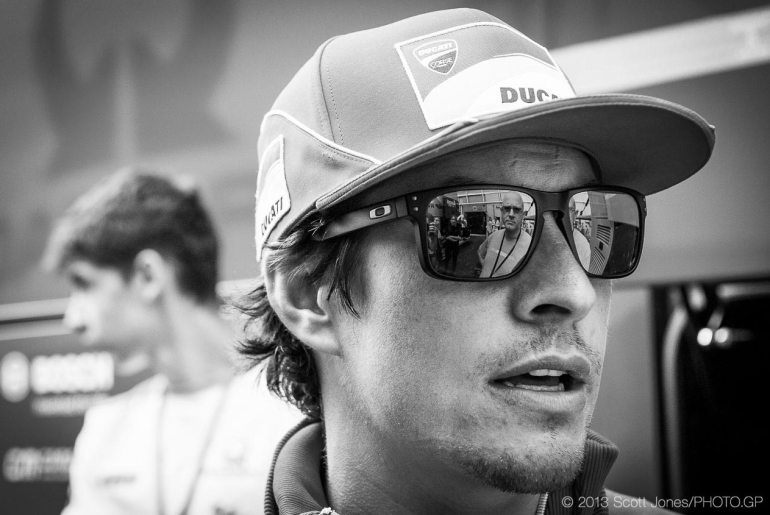
In the penultimate part of our restrospective on the season just past, we look back at Nicky Hayden. Here is our view of his final season with Ducati, and his move to Aspar for 2014. To read the rest of our reviews of last year, you can read part 1, Marc Marquezpart 2, Jorge Lorenzopart 3, Dani Pedrosapart 4, Valentino Rossipart 5, Cal Crutchlowpart 6, Alvaro Bautistapart 7, Stefan Bradl; and part 8, Andrea Dovizioso.

It’s been a tough few years for Nicky Hayden. Since joining Ducati in 2009, his results have been in steady decline, along with the performance of the Desmosedici. The 2013 season was the second season in a row where the American did not score a single podium, Hayden finishing in the same position as 2012, with four more points than last year.

This year was probably his toughest with the Italian manufacturer. Hayden found himself battling with teammate Andrea Dovizioso just about all year long, starting from the first race in Qatar. The Ducatis were a match only for each other, not for the other prototypes.

In twelve of the eighteen races, Dovizioso and Hayden finished behind each other, the only other rider they regularly tangled with being Bradley Smith, a MotoGP rookie. More times than not, Hayden emerged as loser of the intra-Ducati battles, finishing behind Dovizioso nine times, and ahead of him only seven times.

The fact that Hayden was not beating his teammate would end up costing him his job. The American was left waiting for a long time for word from Ducati, though by the time the circus rolled up in Assen, Hayden could see the writing on the wall. “I’m not feeling it,” he said, Ducati not even approaching him about a renewal.

At the Sachsenring, he was told there was no place in the factory team for him, though Ducati were keen to keep him in the family, trying to persuade him to switch to World Superbikes to race the Panigale, or else line up in the Pramac team with factory backing.

In the eighth instalment of our series looking at 2013, we come to Andrea Dovizioso. This is how the Italian got on in his first year at Ducati. To read the rest of our reviews of last year, you can read part 1, Marc Marquezpart 2, Jorge Lorenzopart 3, Dani Pedrosapart 4, Valentino Rossipart 5, Cal Crutchlowpart 6, Alvaro Bautista; and part 7, Stefan Bradl.

After losing his factory Honda ride at the end of 2011, Dovizioso made the switch to Yamaha, joining Cal Crutchlow in the Tech 3 team. A strong year with six podiums saw him win the slot in the factory Ducati team vacated by Valentino Rossi. Dovizioso felt he deserved a factory ride, and he had got what he wanted.

That proved to be something of a poisoned chalice. The year after Ducati was taken over by Audi proved to be a year of stagnation, with new head of Ducati Corse Bernhard Gobmeier never really able to impose his authority on the race department.

A lot of work was done with chassis stiffness, a new aerodynamics package was unveiled, the engine received a minor upgrade with improved throttle bodies. It all helped, a little, but the bike still had understeer — still wouldn’t turn.

Dovizioso started the season with some hope, racing with real determination and guts. Early in the season, he had some good results, getting close to the podium at Le Mans in the pouring rain, and then following on with strong race at Mugello, aided no doubt by the amount of testing Ducati does at the circuit.

But as promised upgrades failed to materialize, and the full seriousness of his situation started to sink in, Dovizioso’s mood took a dive. An air of despair hung around him, the Italian resigning himself to a lost season.

Continuing our look back at 2013, we come to seventh place man Stefan Bradl. Here’s how he fared in 2013. To read the rest of our reviews of last year, you can read part 1, Marc Marquezpart 2, Jorge Lorenzopart 3, Dani Pedrosapart 4, Valentino Rossipart 5, Cal Crutchlow; and part 6, Alvaro Bautista.

In his first season of MotoGP, Stefan Bradl did exactly what was expected of him, learning slowly, building speed, and getting better week after week. He impressed his team, crew chief Christophe ‘Beefy’ Bourguignon expressing admiration at his calm and intelligent approach after the first test on the bike.

He did not crash too often, finished inside the top six on a regular basis, and even got close to his first podium.

After such a strong start, he was expected to do even better in year two. The target was the occasional podium, and to be the best of the satellite riders.

Strong support from Honda meant that Bradl had the tools to do the job, though starting the season using Nissin brakes instead of Brembo put him at a slight disadvantage, the Nissins offering fractionally inferior brake release.

Though Bradl improved, consistently finishing inside the top six, it was not what he or Honda had hoped. The Aragon test in June gave Bradl a boost, trying the same forks which the factory riders had already been using, and switching to Brembo brakes, at least at the front.

In part six of our series looking back at 2013, we reach Alvaro Bautista. Below is our view on Bautista’s season in MotoGP. You can catch up with the rest of this series here: part 1, Marc Marquezpart 2, Jorge Lorenzopart 3, Dani Pedrosapart 4, Valentino Rossi; and part 5, Cal Crutchlow.

Alvaro Bautista is arguably MotoGP’s most under-appreciated rider. A former 250cc champion, the Spaniard has been on a downward trajectory since moving to MotoGP, through no real fault of his own. First, he signed with Suzuki, making him a factory rider with MotoGP’s weakest factory.

After Suzuki left, Bautista moved to Gresini, where he rides for a pittance, and is forced to earn his keep as a test rider for Showa and Nissin. Left to fight against the industry standard Ohlins and Brembo on his own, Bautista does not get the recognition he deserves even when he is punching above his weight.

After a year of evolution in MotoGP which brought them few rewards, Ducati looks set for a radical shake up for next season. Respected Italian website GPOne.com is reporting that Ducati is considering racing in MotoGP as an Open entry, instead of under the Factory option.

In practice, Ducati would be free of the engine freeze in place for Factory Option teams in 2014, have 24 liters of fuel instead of 20, and twelve engines per season instead of just five. In addition, they have more freedom to test with factory riders Andrea Dovizioso and Cal Crutchlow.

In exchange, they will have to forego the freedom to develop their own software, and will run the spec Dorna-supplied software instead.

The fifth part of our series looking back at 2013 sees us turn to Cal Crutchlow. Here’s a perspective on his 2013 season. You can catch up with this series here: part 1, Marc Marquezpart 2, Jorge Lorenzopart 3, Dani Pedrosa; and part 4, Valentino Rossi.

In 2011, Monster Tech 3 boss Herve Poncharal cursed the day he signed Cal Crutchlow to a two-year contract. The 2010 World Supersport champion was struggling to get to grips with MotoGP, finding the tires harder to deal with and the level of competition higher than he expected.

In 2012, Poncharal’s took back most of what he said about the Englishman, and in 2013, Crutchlow rewarded Poncharal’s patience in spades.

This was the year of the great British motorcycle racing revival. Cal Crutchlow looked to be the first Brit to win a premier class race since Barry Sheene in 1981, and Scott Redding looked to be the first British Grand Prix champion since Sheene in 1977. Neither man would succeed in their objective, but they generated a surge of enthusiasm for the sport back in their home country.

In the fourth part of our series looking back at 2013, we take a look at Valentino Rossi’s season. To catch up with previous instalments, you can read part 1 on Marc Marquezpart 2 on Jorge Lorenzo, and part 3 on Dani Pedrosa.

Valentino Rossi left Ducati at the end of 2012 with a palpable sense of relief. At last he would be back on a bike with a front-end he could trust, and could get back to being competitive. The goal was to test himself, to see if he could still run at the front with the Jorge Lorenzo and Dani Pedrosa, he repeatedly told reporters in the preseason.

Testing looked promising. Rossi was a little way behind the Hondas, but so was his teammate Jorge Lorenzo, and that was the man he had to measure himself against. At the first race, Rossi was straight onto the podium, dishing out a lesson in racecraft to Marc Marquez along the way. It looked like he was finally back in business.

Qatar turned out to be something of a false dawn. Rossi struggled in Austin, and could only manage a distant fourth at Jerez. That was an omen of things to come, Rossi racking up a grand total of 8 fourth places during the season, only getting on to the podium when one or other of the top three were injured or otherwise struggling.

Despite the difficulty, the wily veteran still managed to bag himself a win at Assen, his first in nearly three years. It was a moment of release for the Italian, but even during the press conference, he conceded that his win was in no small part due to his teammate’s injured collarbone. Rossi cemented his place in the MotoGP hierarchy: the fourth best rider in the world.

In part three of our series looking back at 2013, we review the performance of Dani Pedrosa last season. If you missed the first two instalments, you can read part 1, Marc Marquez, and part 2, Jorge Lorenzo.

Dani Pedrosa – Championship Position: 3rd – Rating: 9/10

At the end of the 2013 season, some sections of the media took great delight in writing off Dani Pedrosa, after he failed yet again to secure a MotoGP title at his eighth time of trying. Surely Pedrosa’s days at the Repsol Honda team were numbered, as he consistently fails to deliver on the promise he showed in the 125 and 250 classes?

It is easy to dismiss Pedrosa as MotoGP’s ‘nearly man’, and consign him to the dustbin of history, but to do so is to ignore Pedrosa’s actual results.

Dani Pedrosa won three races in 2013, was on the podium a further ten times, moved ahead of Kevin Schwantz, Wayne Rainey and Kenny Roberts in the all-time MotoGP rankings, and now has the same number of second- and third-place finishes as Valentino Rossi. After Assen, Pedrosa was leading the championship by nine points.

What stopped Pedrosa was the one factor which has dogged his career throughout: ill fortune. The crash at the Sachsenring can be put down to Pedrosa’s own mistake, the Spaniard getting caught out by conditions after a brief rain shower.

Continuing our look back at 2013, here is the second part of our rating of rider performances last season, covering championship runner up Jorge Lorenzo. If you missed part 1, on Marc Marquez, you can catch up here.

Jorge Lorenzo – Championship Position: 2nd – Rating: 9/10

After as close to a perfect year as you can get in 2012, Jorge Lorenzo faced a major challenge in 2013. Defending his 2010 title, Lorenzo found himself pushing right at the limit to try to match the pace of Casey Stoner. He had hoped defending his 2012 title would be a little easier, but that would prove not to be the case.

Ironically, Lorenzo ran up against the same problems in 2013 that he had faced in 2011: a game-changing newcomer at Honda, on a bike developed specifically to beat the Yamaha. In 2011, the game-changer had been Casey Stoner; in 2013, it was Marc Marquez.

Lorenzo started the year well at Qatar, but raced at Austin knowing he could not beat the Hondas. At Jerez, he got a rude awakening, when Marc Marquez barged him aside in the final corner. His worst finish since his rookie year at Le Mans was followed by two wins, Lorenzo regaining his confidence and feeling he had the championship back under control.