Tag

MotoGP

Browsing

Got some time to waste? We have just the thing for you, thanks to our friends at Yamaha. The tuning fork brand has long made papercraft models of its various products — scale models made only out of paper, and not to be confused with origami —  and the different designs have been swirling on the internet for as long as we can remember.

Available for download are patterns for building a range of motorcycles, like the Yamaha MT-01, Yamaha YZF-R1, and Yamaha VMAX, and while Yamaha provides the blueprints, you must supply the sheets of paper, bottles of glue, and buckets of patience — this not an undertaking for the ADD inclined.

Now in time for the new year, Yamaha has released perhaps the mother of all papercraft projects, a diorama of Valentino Rossi’s Corkscrew pass on Casey Stoner at Laguna Seca.

It took papercraft designer Mr. Mukouyama a year to design and create the kit, and the detail shows. Getting a chance to show his masterpiece to The Doctor himself, who praised Mukouyama-san’s hardwork, the young artist will have a hard time topping this.

Whether you are riding out the Northeast’s current Freezepocalypse, or just counting down the months until the racing season begins again, here is a new garage endeavor for your undertaking. If any A&R readers complete this papercraft diorama, you must send us some photos of it. We’ll send you a shirt or something.

As 2014 gets underway, we start our build up towards the upcoming MotoGP season. This starts an all-week look back at the performance of the riders in 2013, rating the top ten in the championship, as well as exceptional performers from last year. Later this month, we will start to look forward, highlighting what we can expect of the season to come, both in terms of riders and the new regulations for 2014. The new season starts here.

Marc Marquez – Championship Position: 1st – Rating: 9/10

How would Marc Marquez fare in MotoGP? It was the question on everybody’s lips at the start of 2013, as the young Spaniard left the class he had dominated to play with the big boys. It would be Marquez’s moment of truth: throughout his career in the junior classes, he had always been in the best teams.

Many outside observers also claimed he had been on the best bike in Moto2. In 2013, Moto2 teams who had competed against him were free to concede that Marquez had won despite his Suter, not because of it.

Their words were backed by Marquez’s action. Accepted wisdom holds that a rookie year is for learning, for getting to grips with a MotoGP bike, having a few big crashes, chasing the odd podium and maybe even a win. Marquez did all that and more, but how he did it marked him out as one of a kind.

His first podium came in his first race, the Spaniard benefiting from problems Dani Pedrosa suffered with the dusty Qatar surface. His first win came a race later, smashing what would be one of many records in MotoGP.

Youngest race winner, youngest champion, youngest rider to set a fastest lap, youngest polesitter, youngest back-to-back winner, youngest to win four races in a row, most wins as a rookie, most poles as a rookie, highest points total for a rookie; the list goes on and on. Marquez broke records held by Freddie Spencer, Kenny Roberts, Mike Hailwood. These are very big boots to fill, yet fill them he did.

When Suzuki decided to move their return to MotoGP back a year, from 2014 to 2015, questions were raised over just how serious they are about actually coming back. The odds appear stacked against them: the bikes were some way off the pace, over 1.8 seconds at Misano.

Suzuki is still working with their Mitsubishi electronics unit, not yet having moved to the Magneti Marelli unit which is compulsory from 2014, and coming to MotoGP in 2015 would leave them just two seasons before a new set of regulations is to be introduced, likely to include a rev limit and compulsory spec software. Suzuki face an uphill task.

Despite the challenges, they seem determined to come back to motorcycle racing’s premier class. One sign of their intent is the launch of a new four-part video series on the progress made on the MotoGP project, the first video of which was released yesterday.

The 2014 MotoGP season marks a key point in the evolution of Grand Prix racing. Next season, all entries in the MotoGP class must use the Magneti Marelli standard ECU and datalogger as part of their hardware package. For the first time in history, electronics have been limited in motorcycle racing’s premier class.

It is a small victory for Dorna and the teams; however, only the hardware has been regulated. All entries must use the standard ECU, but the choice of which software that ECU runs is up to the teams themselves.

If a team decides to run Dorna’s standard software, they get extra fuel to play with, and more engines to last a season. If a factory decides they would rather write their own software, they are also free to do so, but must make do with only 20 liters to last a race, and just five engines to last a season.

The difference between the two – entries under the Open class, using Dorna software, and as Factory option entries using custom software – is bigger than it seems. Open class entries are stuck with the engine management strategies (including launch control, traction control, wheelie control, and much more) as devised and implemented by the Magneti Marelli engineers, under instruction by Dorna.

Factory option entries will have vastly more sophisticated strategies at their disposal, and manufacturers will be free to develop more as and when they see fit.

The freedom to develop electronics strategies has been a deal-breaker for the factories throughout the four-stroke era. The change in capacity from 990cc to 800cc in 2007 vastly increased the importance of electronics in the overall package, with more and more money going into both the development and the management of electronics strategies.

The combination of a vast array of sensor inputs, fuel injection, and electronic ignition has meant that vehicle control has moved from merely managing fueling to dynamic and even predictive engine management. Engine torque is now monitored and managed based on lean angle, bike pitch, tire wear, fuel load, and a host of other variables.

So it comes as no surprise that Honda is already making threatening noises over the regulations due to come into force from 2017 onwards. Dorna intends to remove the freedom for factories to use their own software from 2017 onwards, with all bikes using the same, spec, Dorna-supplied software, as currently being developed for the Open category.

A new chapter is to be written in the long and illustrious history of motorcycle racing on Montjuic, the hill that borders the south side of Barcelona. On January 11th, a selection of Grand Prix racers, including all three world champions Marc Marquez, Pol Espargaro and Maverick Viñales, are to compete in the Superprestigio dirt track event to be held at the Palau Sant Jordi on Montjuic. The event is to be broadcast on Spanish TV

The race is to be held on single cylinder four-stroke flat trackers, raced around a 200 meter dirt oval inside the former Olympic indoor arena. Entry is by invitation only, and racing will take place in three separate classes: the Junior category, for riders under 18; the Open category, for experienced riders from around the globe racing in national championships; and the Superprestigio category, for riders currently competing in the MotoGP, Moto2 and Moto3 classes. At the end of the evening, a run off is to be held between the four best racers in the Open category and the four best from the Superprestigio category.

The entry list for both categories is impressive. The Superprestigio category will see Marc Marquez, Pol and Aleix Espargaro, Maverick Viñales, Bradley Smith, Alvaro Bautista, Julian Simon, Jonas Folger, Moto3 teammates Alex Marquez and Alex Rins, Hector Barbera, Tito Rabat, Johann Zarco, Niklas Ajo, Jordi Torres, Lorenzo Baldassari and Ricky Cardus race against one another. Nicky Hayden was also invited, but as he has just had wrist surgery, wisely but regretfully decided to pass on the event.

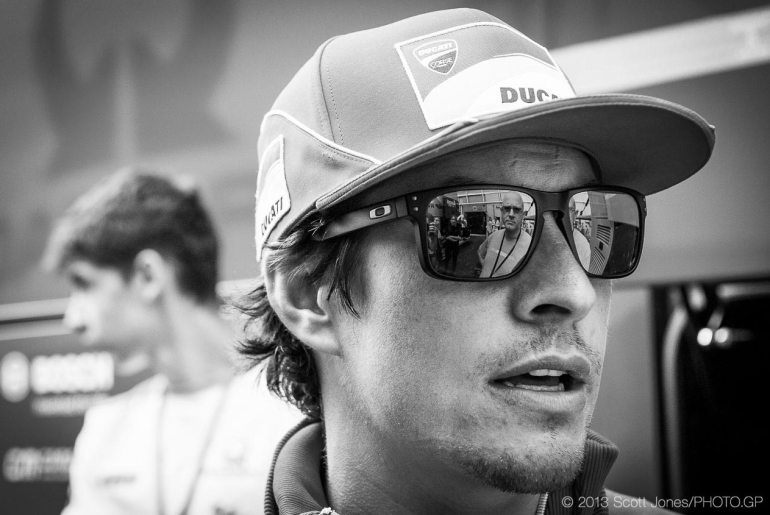
I am very proud to announce that my good friend and colleague David Emmett (check the reflection in Nicky’s sunglasses) has been named, not once, but twice in the 2013 Silverstone Media Awards for his coverage of the MotoGP Championship and for his website MotoMatters.

For the third year in a row, David has been named the Best MotoGP Blogger, something we already knew here at Asphalt & Rubber, which is why we feature his work, and this year marks David’s first time as the series’ top account on Twitter.

David is too humble to do anything other than announce his hat-trick of trophies, but I have no problems saying that his work is the definitive source for MotoGP commentary.

David’s true journalistic ethic and keen understanding of the internet as a medium of information has quickly distinguished him from his colleagues in the MotoGP paddock, and for all the hard work of his that we read on our computer screens, there is an iceberg of change underneath MotoGP’s murky waters that he has brought about.

Keep up the excellent work my good friend, I think I speak for all the Asphalt & Rubber readers when I say that Silverstone couldn’t have recognized a better man in MotoGP.

If you want to help support David’s site MotoMatters, you can take out a subscription; get one of the stunning MotoMatters.com 2014 Motorcycle Racing Calendars; buy a print from Scott Jones’ website; or simply make a donation.

Casey Stoner is to continue as test rider for Honda in 2014. The Australian double world champion will once again take the track to help develop Honda’s RC213V during the 2014 season, according to British publication MCN.

Stoner took up his role as test rider in the middle of 2013, after HRC’s regular test rider Kousuke Akiyoshi broke his femur at a Japanese Superbike round. The Australian worked on the 2013 RC213V, as well as a rain-shortened test on Honda’s RCV1000R production racer.

According to the report on MCN, Stoner’s testing schedule for 2014 has yet to be fixed. It appears that Stoner will not be present at the special tire test put on by Bridgestone at Phillip Island, which all three factory teams will attend, but he will take on further testing duties at Motegi later in the season.

Last year’s Grand Prix of the Americas was marred by the dispute between Kevin Schwantz and the Circuit of the Americas, which saw the former GP Champion accusing the new MotoGP circuit of cutting him out of a deal with Dorna, the media rights holder to MotoGP.

The legal dispute has simmered since the MotoGP race, but it is unfortunately finding a new spotlight now, as a court date has been set. Scheduled February 10, 2014 as a ten-day trial, Schwantz and COTA will get to argue their claims before a jury of their peers in Austin, Texas.

At its final meeting of 2013, the MotoGP Grand Prix Commission has agreed changes to the regulations for the three Grand Prix classes, mostly minor, but a couple with much wider implications.

Changes were agreed to the penalty points system, to the procedure for restarting interrupted races, for protests, and for wild cards. But the biggest changes made were to the Moto3 class, and the loophole which allowed manufacturers to charge what they wanted for chassis has been closed, capping prices in Moto3 even further.

The first major change to the 2014 MotoGP schedule has been announced. Though the dates remain the same, the order of the Asian flyaway triple header has been reshuffled, with Sepang moving from first of the three to last.

The Grand Prix classes will now head to Japan first, for the Japanese GP at Motegi on 12th October, before heading south to Australia for the Phillip Island round a week later, on 19th October. The weekend after that the MotoGP paddock visits Malaysia, for the last of the three overseas races at Sepang on 26th October.