Tag

Popular

Browsing

In a few hours, the TT Zero race will kickoff for the 2013 Isle of Man TT, and if the practice and qualifying sessions are any indication, it should be a close-fought race between the 2013 Mugen Shinden Ni of John McGuinness and the 2013 MotoCzysz E1pc race bikes of Michael Rutter and Mark Miller (Update: The SES TT Zero race report can be found here).

McGuinness has been fastest so far with the Mugen Shinden Ni, posting a 109.038 lap during Monday’s qualifying session, while Rutter and Miller posted 107.817 mph and 105.806 mph laps, respectively. On the course, this means McGuinness is roughly 16 second faster than Rutter, a notable difference, but not a huge margin in this class, which sees huge (by TT standards) speed leaps from session to session.

Hoping to make it four wins in a row, it goes without saying that the MotoCzysz crew is working hard to close the gap. However, having Team Principal Michael Czysz stuck back in the US, undergoing cancer treatments, must certainly add another level of motivation for the on-island MotoCzysz crew.

Making time in their busy schedule, Asphalt & Rubber got to take some up-close photos of the 2013 MotoCzysz E1pc. Check them out after the jump, you won’t see better photos of the ’13 E1pc anywhere else.

Max Biaggi is to make a surprise return to riding a MotoGP machine. The former 250 and World Superbike champion will take a seat on Ben Spies’ Ignite Pramac Ducati as part of a one-day test at Mugello, as part of Ducati’s testing program, according to Italian site GPOne.

Spies was scheduled to stay on at Mugello to take part in a two-day test, but after the first day of practice at last weekend’s Italian Grand Prix, it was clear to both Spies and Ducati that his shoulder was still too weak to ride a MotoGP machine. With work continuing on the Desmosedici, it was important for Ducati to get as much data as possible on their bike, and so Biaggi was offered the chance to ride the machine.

Just as our Bothan spies had predicted, the folks in Varese, Italy have debuted an 800cc version of the MV Agusta F3. The new machine is cleverly named the MV Agusta F3 800, and as you may expect, the street bike features the 798cc three-cylinder engine that is found on the MV Agusta Brutale 800 and the still unreleased MV Agusta Rivale.

Pepping that three-cylinder motor up to 146hp (note: MV Agusta continues to have some trouble converting kW into horsepower, and other publications continue to fail at checking MV’s math. Last we checked, 108.8 kW equalled 145.9 hp), MV Agusta has wedged the lump into its supersport chassis, and reports that no additional weight has come as a result.

I am just wrapping up my thoughts on the new liquid-cooled 2013 BMW R1200GS, but before I post up the ride review, I thought I would share this little gem of a video that BMW Motorrad USA showed us at the US media launch for the R1200GS. Filmed at the Circuito de Almería in Spain, a new BMW R1200GS gives chase to a BMW HP4, and interesting results ensue.

Now I’m not saying that the R1200GS is a more capable track bike than the HP4, a fast rider on any bike is still a fast rider, after all. But, you have to be impressed by the GS here, it certainly wasn’t losing any ground to the HP4 (except maybe on the straight). As for the the nitty gritty, the R1200GS rider clocked a sub-two-minute lap time, an entirely respectable time at the Spanish circuit, which sees WSBK-spec machines lap in the 1:35 range.

BMW Motorrad says the 2013 BMW R1200GS is like the Swiss Army knife of the motorcycle world, and with some on-track chops like this, we might just have to agree. For those that are wondering, it rides nice on the road and trails as well. Video after the jump, and look for the review this week.

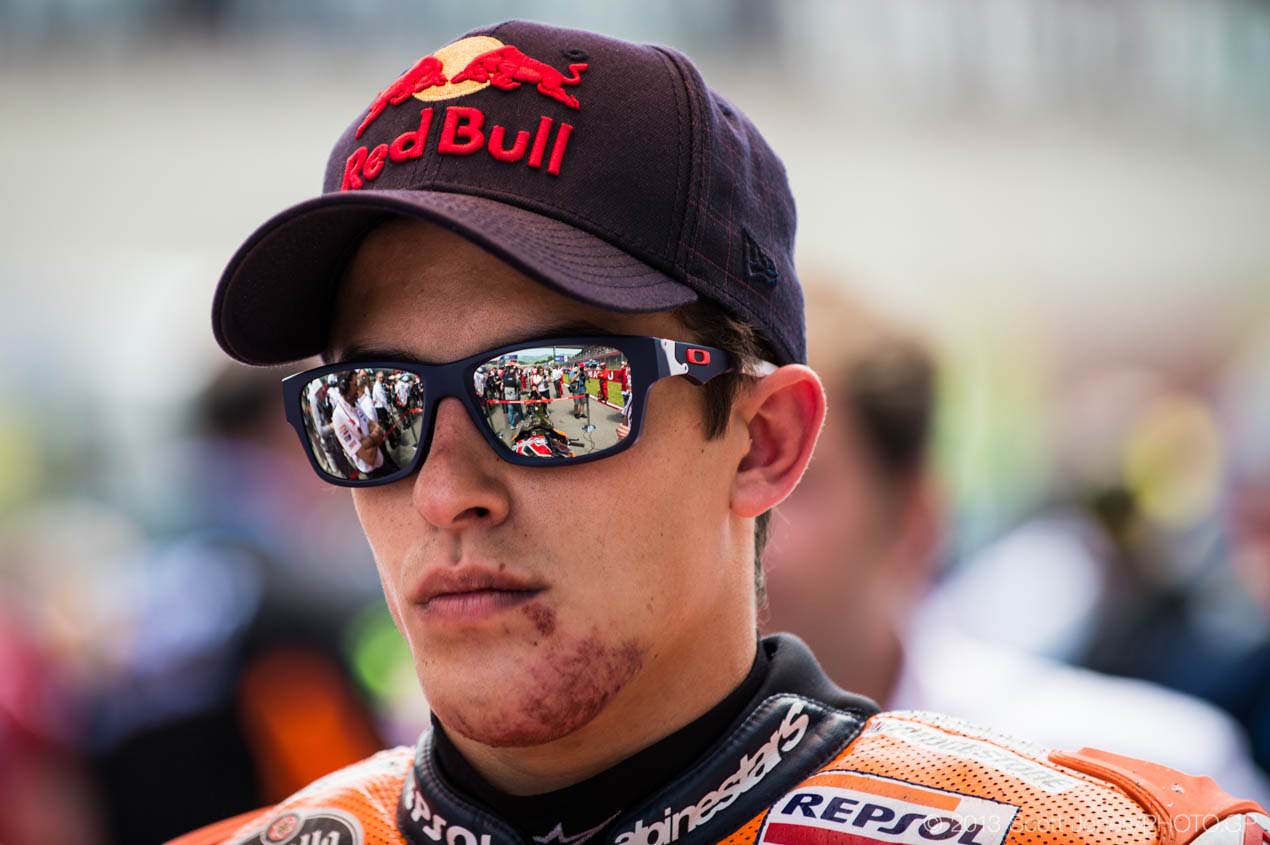
Marc Marquez would almost certainly like to forget this past weekend at Mugello for the Italian GP. Heads up to the spoiler alert, but not only did he make an unforced error during the race, crashing out of second place all by his lonesome (with a comfortable margin fore and aft, we might add), but the young Spanish rider also had one of the fastest crashes ever in the MotoGP Championship during Friday’s Free Practice 2 session.

Losing control of his Repsol Honda RC213V at 209.9 mph as he approached the San Donato corner during the race, Marquez had to jump away from his race bike, at roughly 170 mph, in order to avoid the rapidly approaching wall barrier. Escaping with a battered chin, a small fissure to his humerus bone, as well as minor soft-tissue injuries to his shoulder, Marquez came out of the incident in FP2 rather well, all things considered.

Now that Marquez has gotten a clean bill of health from doctors in Barcelona (he will have to undergo some physio the next few days though), Repsol and others in the paddock can breathe a sigh of relief, and begin to analyze the crash in more detail. Helping add insight to the crash, Alpinestars has released the telemetry from Marquez’s Tech Air race suit, which shows the g-forces involved during the crash, as well as the deployment time of the suit’s airbag.

Fresh off the news that it would be making the highly touted Mission RS (previously known at the Mission Motors Mission R), Mission Motorcycles announces its own version of the Mission R, a $30,000 (base price) electric superbike that builds off the pedigree of its namesake.

Like the Mission RS, the Mission R features a 160 hp liquid-cooled three-phase AC motor as its power plant, which is mated to a single-speed gearbox with a gear reduction. Also featuring that same James Parker designed “Quad-Element” frame, the Mission R makes its differentiation from the Mission RS in the spec of its components.

Coming with Öhlins RT suspension rear and aft, Brembo M430 monobloc brakes, and Marchesini forged aluminum wheels, the component company names are of course the same, albeit not the WSBK/MotoGP-spec kit that comes on the RS. Available in 12 kWh, 15 kWh, and 17 kWh battery options, the lower-spec equipment (high-spec by any other metric) helps lower the price of the 12 kWh machine to a paltry $29,999 (after a $2,500 federal rebate), with the 15 kWh & 17 kWh machines presumably priced with larger price tag (Mission left that part out of the press release).

After the Dainese Superbike TT race was pushed from Saturday’s debut time slot to Sunday, it seems the first solo-classs race was worth the wait as it put on quite the show for Isle of Man TT fans.

In addition to the victory by the popular Michael Dunlop, and a stellar performance by newcomer Josh Brookes, John McGuinness also made waves, first with his pit lane time penalty (McGuinness was levied a one minute penalty by the stewards), but more notably with his record-setting 131.671 mph lap on the sixth lap of the race.

Another Italian GP at Mugello, and another special AGV helmet for Valentino Rossi. A wink to his new non-alien status, Rossi’s AGV Pista GP lid is obviously painted up like a turtleshell, implying the Italian’s pace to his rivals (note  the colored figures running along the chin bar of the helmet).

Whether you are a fan of The Doctor or not, you have to admit the G.O.A.T. is taking his new place in MotoGP in stride (at least publicly)…though don’t count him out just yet. Second-fastest in FP1 & FP2 on his 2013 Yamaha YZR-M1, Rossi was also fourth-quickest in this morning’s FP3 session — counting him out of a podium, and even a race win, at Mugello would be unwise.

At the 2013 Isle of Man TT, when it comes to the TT Zero race, there are really only two entries being talked about: MotoCzysz and Mugen. Rumored last year to be a black hat electric superbike project for Honda, Mugen of course denies such involvement, though admits that company’s share a very special and close relationship.

Whether you believe that an association exists or not, the paddock gossip says that Mugen (or Honda) has spent nearly $4.3 million on its electric bike project, and that sounds like a number that is well within the ballpark. With John McGuinness at the helm, Mugen is taking the TT very seriously, and looking at the 120 hp Mugen Shinden Ni, you can see that the Japanese squad has spared no effort in giving McPint the most potent weapon possible.

As we suspected, the Mission R by Mission Motors lives, albeit in a new company and with a new name. Coming from Mission Motorcycles, the now-called Mission RS (race special) is the realization of what we consider to be the finest road-going electric motorcycle…and we should know, we’ve ridden them all.

Essentially the electric race bike that Steve Rapp piloted to Supersport class lap times at the Laguna Seca MotoGP/AMA/e-Power round in 2011, but with a headlight, taillight and mirrors, the Mission RS boasts some impressive figures.

Sport bike enthusiasts will enjoy the quoted 160hp horsepower, 120 lbs•ft of torque across the rev range, and 17 kWh battery pack, which Mission says is good for a 200 mile range (140 mile real world) and a 150 mph top speed. However, the $58,999 price tag may take some getting used to (insert sticker shock joke here, as well as corresponding eye roll).

MotoGP’s Claiming Rule is set to be consigned to the history books. At the next meeting of the Grand Prix Commission at Barcelona, a proposal will be put forward to abandon the claiming rule altogether.

With the advent of the new distinction, between MSMA entries and non-MSMA entries, the need to claim an engine ceased to exist. The demise of the claiming rule opens the way towards the leasing of Yamaha engines to private teams without fear of those engines being claimed by other factories.

The claiming rule had been instigated at the start of 2012, to allow the grid to expand. At the end of 2011, with the departure of Suzuki, and both Honda and Ducati cutting back the number of satellite bikes they were prepared to provide, numbers on the MotoGP grid looked like falling to as low as 13 or 14 bikes.

The switch back to 1000cc engines meant a rich spectrum of engines was available to custom chassis builders, to produce affordable race bikes. To allow such teams to compete with the full factory efforts, such teams were allowed extra fuel (24 liters instead of 21), and double the factory engine allowance, 12 instead of 6.

To prevent new factories from taking advantage of the loophole, the MSMA members – the factories involved in MotoGP – retained the right to claim the engine of such teams. Hence the name, Claiming Rule Team or CRT.