It has been a busy year for MotoGP Race Director Mike Webb. Since taking on the job of ensuring that MotoGP events take place safely and efficiently, stepping into the shoes vacated by Paul Butler at the start of the 2012 season, Webb has faced some tough decisions and unusual situations, his second year in the job even more eventful than the first.

In response to criticism over the warning system in 2012, a new penalty points system was introduced to allow for harsher penalties for persistent offenders.

There were several high-profile incidents involving Marc Marquez in his rookie season, including a clash with Jorge Lorenzo at Jerez, a touch which severed the traction control sensor of teammate Dani Pedrosa’s Honda and caused Pedrosa to crash, and the situation at Phillip Island, where the new asphalt at the circuit caused the tires to degrade much more than the two spec tire manufacturers had expected, requiring last-minute adjustments to the race schedule on the fly.

We spoke with Mike Webb extensively at Valencia, on the Thursday evening before the race, covering the above subjects and more, and reviewing his second year as Race Director.

In the first part of the interview, Webb talks of whether motorcycle racing is a contact sport, how the penalty system has worked out, explains why Marc Marquez was not given points at Jerez, why Jorge Lorenzo wasn’t penalized for the touch at Sepang, and of changing perceptions.

Bikes

Behold the Suzuki XRH-1 MotoGP race bike prototype that has been the subject of so much conjecture in the MotoGP paddock. On display at the Suzuki stand at the 2013 EICMA show, it was perhaps the most technologically advanced motorcycle at the yearly motorcycle event, yet you would only know that if you went to Milan last week. Finding an inline-four engine at its heart, Suzuki hopes to bridge the gap between MotoGP and street bike a bit with this entry, which is a good thing since the current generation GSX-R is going on its sixth model year. It appears until Suzuki re-enters MotoGP or builds a new superbike for the street, these photos are all we have to drool over from Hamamatsu. That will suffice…for now.

Lifestyle

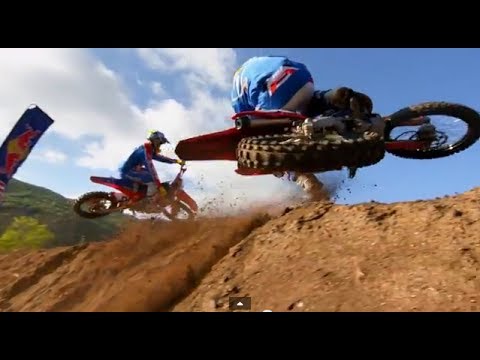
As a member of the Nintendo-generation, nothing tickles my fancy more than to see an homage to some of the classics, and for motorcyclists is there any title more prolific than Excitebike? I think not. So it warms my gamer hearts to see that Red Bull has explored the idea of a real-life Excitebike course with its “straight rhythm” project. Red Bull says that the course is “an innovative evolution of supercross where a track is ‘unwound’ — there are no turns, just a half-mile-long straight rhythm section. By isolating the whoops, triples, doubles, table tops and step on/offs, riders must focus exclusively on reading the terrain directly in front of them, correctly judging their speed for precise distance and control.”

Bikes

The Tokyo Motor Show is next week, and while we expect Honda to debut the Honda Gold Wing F6C at the show, it looks like Yamaha is set to make some waves as well. Teasing four concept motorcycles, two have caught our interest. First up is the Yamaha PES1 concept, which is an electric sport bike with a DC brushless motor and lithium-ion battery. Yamaha is light on details, and we can imagine that the concepts are meant more to illustrate that the tuning fork brand is “thinking about” electrics, as is the vogue with OEMs at the moment. However, the design is interesting, especially with Yamaha suggesting that the battery pack, called the Yamaha Smart Power Module, is swappable on the sub-100kg machine.