The competitors for the 91st Pikes Peak International Hill Climb have just concluded a two-day tire test at the Colorado road course, and it should perhaps come as no surprise that our boy Carlin Dunne has posted the outright fastest lap for a motorcycle during the tire test (the Santa Barbara native set the outright two-wheeled course record last year on his Ducati Multistrada 1200 S). What is surprising about Carlin’s result at the tire test is that he was on the Lightning Motorcycles electric superbike. That’s right, the fastest bike so far for 2013′s Race to the Clouds is a 200+ hp electric superbike that is refueled with solar energy. Petrol heads, eat your heart out.

Talking to the Indy Star, Mark Miles (CEO of Hulman & Co, the parent company to Indianapolis Motor Speedway) has put some doubt into the historic venue’s commitment to host the MotoGP Championship. Having a contract to run the race through the 2014 season, Miles said that IMS might opt-out of the final year in its agreement with Dorna (IMS apparently has this option for a brief window after the 2013 Indianapolis GP). However while the news has focused so far on IMS’s ability to opt-out, both Dorna and Indianapolis Motor Speedway have options in their contract to go through with the 2014 round, and with a bevy of variables in the air, we may or may not see three American GP rounds next year.

Surprise! America will be getting a 847cc three-cylinder naked bike for the 2014 model year, the 2014 Yamaha FZ-09. Replacing the Yamaha FZ8 in the Japanese company’s line-up, the FZ-09 is the first motorcycle from the tuning fork brand to sport the Yamaha’s new line of three-cylinder engines. The Yamaha FZ-09 comes about as the MIC is reporting its second-consecutive year of growth in the 751+cc sport bike segment, as well as increase in commuter riding over short-distance sport riding. With those trends in mind, Yamaha has punched out the displacement on its middleweight naked bike, and focused on giving riders a comfortable, yet stout, motorcycle. Priced at $7,990 MSRP, we think Yamaha hit the nail pretty much on the head with this one.

In the past few years I’ve come to believe that, while superior physical differences (their reflexes and fine motor skills) are significant, it’s the mental differences that are the most interesting. I suppose anyone who has ridden a motorcycle even a bit beyond one’s comfort zone can appreciate some part of the physical aspect of riding a racing bike. For most of us, even the speed of racers in local events is impressive compared to our street riding. While the skills with throttle, brakes, and balance are on a level similar to the best athletes in other sports, I think that what really sets motorcycle racers apart is their ability to overcome fear.

The progress in the last five years on electric motorcycles has been astounding. Taking their first laps around the Isle of Man TT Mountain Course, a 87.434 mph pace was the best an electric motorcycle could do at the prestigious road race in 2009 — a pace that was on par with the 50cc record set in 1971. In just five years after the first laps were taken by electric motorcycles at Snaefell, these machines have grown their average lap speeds by over 20 mph at the TT Zero race, setting a new record of 109.675 mph in 2013, and boasting a rate of improvement of roughly 5 mph each year since 2009. If hitting 142.2 mph down the Sulby Straight speed trap wasn’t further proof of the speeds these bikes are achieving, maybe some visual evidence will help support the notion.

Darius Glover is a dirt bike racer. Like you and me, he lives to ride, and when he is on two-wheels he feels the freedom that only other motorcyclists can truly understand. The thing is though, Darius is paralyzed from the waist down. Where others would give up their dreams and this sport, Darius at the age of 15 instead pushed onward. No pity parties, no excuses, just simply a daily example of where there is a will, there is a way, and a reminder that you can achieve anything that you put your mind to. It’s hard not to get a bit choked up listening to Darius tell his story, but you walk away feeling uplifted after feeling his attitude come across the screen.

Any race where 1,500 riders start, 500 qualify, and only 14 finish, has got to be an epic competition, and considering the fact that the Erzberg Rodeo starts in the excavation pit of an Austrian mine…well, it takes a special rider to be enticed by such an event. One such special rider is Graham Jarvis, who was the first of the fourteen men to reach the 20th and final checkpoint. Taking 2 hours and 52 seconds to complete the course, Jarvis made the 2013 Erzberg Rodeo look downright easy. However, with one look at the race-day conditions from this past weekend, we know it was anything but.

While normally, MotoGP fans never get enough of seeing Valentino Rossi on TV, there is one shot they would (for the most part) gladly be spared. As he leaves the pits, Rossi stands on the footpegs, and pulls his leathers from between his buttocks, before sitting back down again and leaving. These rituals – part useful limbering up, part invocation of Lady Luck – are something many riders perform, in their attempt to exert control over themselves, and over their environment. In a fascinating press release – by far the most interesting we have received in many months – the Aspar team today provided a discussion and explanation of what riders are trying to achieve through the use of these rituals.

Hoping to make it four wins in a row, it goes without saying that the MotoCzysz crew is working hard to close the gap to the John McGuinness and the Mugen team. However, having Team Principal Michael Czysz stuck back in the US, undergoing cancer treatments, must certainly add another level of motivation for the on-island MotoCzysz crew. Making time in their busy schedule, Asphalt & Rubber got to take some up-close photos of the 2013 MotoCzysz E1pc. The most obvious changes made to the MotoCzysz E1pc for the 2013 TT Zero race are the use conventional suspension pieces. Of course, it’s not a completely standard suspension setup, as MotoCzysz has developed its own adjustable triple clamp that incorporates tunable lateral flex parameters.

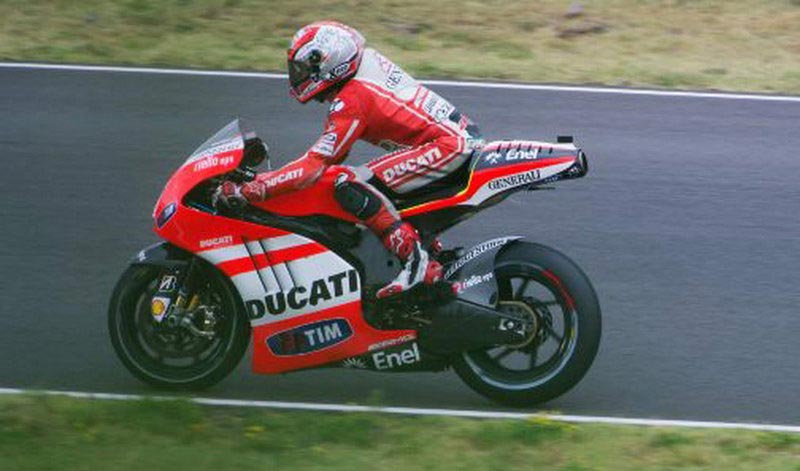
Max Biaggi is to make a surprise return to riding a MotoGP machine. The former 250 and World Superbike champion will take a seat on Ben Spies’ Ignite Pramac Ducati as part of a one-day test at Mugello, as part of Ducati’s testing program, according to Italian site GPOne. Spies was scheduled to stay on at Mugello to take part in a two-day test, but after the first day of practice at last weekend’s Italian Grand Prix, it was clear to both Spies and Ducati that his shoulder was still too weak to ride a MotoGP machine. With work continuing on the Desmosedici, it was important for Ducati to get as much data as possible on their bike, and so Biaggi was offered the chance to ride the machine.

Swing-arm look shorter then GP11… .I may be wrong.
“Unable to test GP11/GP11.1 further, the new chassis is expected to be a 2012 modification, and make its planned public debut at the Valencia test at the end of the 2011 season.”
Why are they not able to use this bike this season? (i thought the teams could do whatever since it is a prototype series…or is the GP12 using the liter motor?)
I won’t say that the GP12 is a liter motor, but it is certainly more than 800cc. The bigger issue is that the GP12 motor mounts differently than the GP11 (note: the GP11.1 motor is based off the GP12 motor, and thus mounts the same).
The speculation is that the GP12 EVO has different mounts from the GP12 motor, and perhaps more importantly, Rossi and Hayden have already taken their sixth motor for the season. Meaning using the new chassis requires a new motor, which in-turn means they’d start from the back of the grid if they used the new chassis. That sort of negates the hope of pushing at the front of the grid.
Never say never though.
Apparently Rossi is testing today at Mugello, not tomorrow.
In my opinion if Ducati ever succeeds to help Rossi being competitive in 2011, they’d better roll the bike and run top6 qualifying times and starting from the pits hopefully overtaking a few riders than starting straight from the back of the grid with the GP11.1…At least they’d show they have a competitive bike and Rossi would gain his confidence back.
Question: do you have a reliable info concerning the FTR aluminum chassis?
This FTR info is all around the web but no one added any substance or precisions to this, just “they are testing with a FTR chassis”. So far it hasn’t been confirmed by any of the interested parties, is it speculation taken from italian media or is it a legit info that you got from reliable sources?
How can you tell that this is the aluminum frame version? /silly question
I doubt that the Aluminum frame is going to make much of a difference. The problem is one of weight distribution due to the 90deg. L4 engine. Ducati will never improve the bike enough to win, until they design a new motor with a narrower v angle to move it closer to the front wheel. Rossi and Hayden both are saying they are having trouble getting enough heat into the front tire. I don’t see how a different frame material corrects this problem.
@Mark: Because they don’t have enough feedback from the front, they cannot push the front of the bike hard enough thus the front tire never gets enough heat (or it takes a really long time for it to eventually heat up, but by then, the rest of the fast guys are long gone).
The idea is that if they can get more feeling from the front, the more confidence they’ll have to push it harder so the tire warms up faster/hotter.
I’m not sure why Ducati would go hire a frame builder to make an Alu. frame when they could simply go modify their tried and tested steel trellis frame. Ducati has so much wealth of informatin on their steel frames, it has been proven that the steel frame set up isn’t “only Stoner can ride” design, since Capirossi, Bayliss and of course Stoner won on that design, and took a title as well. Unless of course they already ran some simulation in a computer and have found that the steel design would not work with the current Bridgestone tires.
Time for Ducati to steal an RC212 and…….see what are they doing wrong on the GP12 ?
Im with Mark here, 90* V Twins are just dang long(no matter how much u tilt it), i own one(SV1000N) and is plain easy to see just how far back the engine is placed to allow for wheel travel-front cylinder valve cover and header clearance issues.
Time to go I-3, I-4 or 60* V4 OR tighter like the Horex ?
Meeehh. what do i know…lol.
I guess they won’t be using the “Frameless like our Moto GP Prototype” Card anymore when the time comes to start selling their new V4 UFO (1199).
This is just my opinion, but I kinda think Ducati is too much of a marketing company than a racing shop. They seem to want to stick to technology that sets them apart from the rest of the field so they have a unique marketing angle to help sell their bikes. However, I personally wouldn’t care if a production ducati didn’t have the same technology as their GP bike.
I really think a winning record will do more for moving their bikes off the showroom floor than having unique tech (although having a winning record with unique tech would be a bonus but its clearly NOT working). But I guess they need to appear as an ‘exotic’ brand to help sell their bikes and accessories.
I think its still all because of the spec tyre rule. In a racing series where tolerances and timings are so close, the riders seem to be able to pick up on the smallest of details. Add to the fact the Ducatis is an odd one out from the rest of the field, it makes sense that the spec tyre works for the majority of the bikes, which are beam framed, and not for the strange Ducati. Spec tyre in Moto2: all generally the same frame types/bike design. It works. Same in F1 which has a spec tyre, the cars are virtually the same, no major radical differences like with the Ducati compared to the rest. Its an example of why rules like this hinder racing “development”. On the other hand, having multiple tyre makes has a bit of a gamble with it, as one manufacturer could make duds compared to the other. How is that hub center bike going to fare in Moto2? If it could have its own manufacturer to cater to its needs then it might do ok, but I just dont see it with the current regs. As Phillipe said, the current rules favour a 4 cylinder V engine, and I think the tyres do the same for the frame, a beam one.
@ ML
Ducati has never put marketing first and racing second. The thing is “their’ series was WSBK, they used WSBK to sell their bikes through in through out for the longest time until they decided to do MotoGP in 2003. Their WSBK record is untouchable, and their current I dare say factory team is walking away with the championship.
Ducati’s bikes for the public are great race bike platforms as shown in WSBK even today. People forget that MotoGP is very far from just about everything we get our hands on. Ok, maybe the electronics have now trickled down to the road because all electrics can be made so cheap nowadays, but mechanical stuff doesn’t trickle down. In all fairness though, not much has changed in the mechanics, still using telescopic forks, a rear shock, an alu. frame, etc. The engines are not amazing, V4′s have been around for a long itme. Like Minibull said, spec rules (tires) hinder development and it’s a big paradox because prototype racing is suppose to be exactly focused on development!
It’s interesting how Checa called out to Rossi to race against him, because Checa’s 1198 times are apparently that of Rossi’s GP 11.1 on the same track. GP’s have stopped developing so much that a production bike can go just as fast (or very very close)
Sometimes I wonder, if Stoner/Lorenzo/Ped/Sic was riding the factory BMW S1000RR or Aprilia RSV4 (the big power bikes with alu frames, esp the BMW) running the GP Bridgestone tire, which were then set up for the ultra stiff Bridgestone, I wonder how close the times would be. The BMW is interesting as they have had massive tire problems in WSBK, chewing the Pirelli’s to nothing cause of the power they have, and not lasting race distance. Now just imagine the Bridgestone on the S1000RR.
The SUTER BMW’s last test at BRNO with Kallio was only 3.9 seconds off from the top tester, Mr. Stoner on the 213V. I read so much flak about how 3.9 seconds is crazy amounts of time. I am willing to bet that at least 2 of those seconds is rider, and the other 1 point something is the bike. Constantly people compare only the bike, but conveniently forget that Stoner is a riding god, and Kallio is a mid fielder Moto2 rider at best, usually a back marker. 3.9sec at Brno too, which is a very long track, is quite good I think, with Kallio as the pilot. I think the CRT teams, at least the Suter BMW isn’t far off, which is very impressive.
Sorry, my post about Ducati morphed into CRT, but just trying to confirm what Minibull has said. The Alu frames suit the tires best. The only way to save from the boredom of MotoGP are the new CRT teams. The very high level of tech/power in the current production superbikes can seemingly compete with the GP V4′s now.
Back to the post. If FTR made the frame and Ducati the engine, isn’t “their” GP12.1 a CRT bike?
They aren’t going to win the title anyway, so who cares if they have to start at the back of the grid… The data is the most important, and the lap times are what you want to really know… I would love to see them start from the back, just to see how high they eventually place… One thing is for sure, Rossi will still finish in the top eight, at least…
@Mark – is Checa having problems with a twin cylinder in this configuration? Not by a long shot….especially compared to aprilia’s 60-degree v4
I doubt adding two more cylinders to the 90-degree configuration is the sole culprit to what is going on. Definitely not enough to justify abandoning the advantages of a 90 degree configuration and adding the expense of a new engine design.
Frame material has a huge affect on many other design elements when pushed to this level. It is not as though you just replace one type of the design and expect perfection. Engineers have been tinkering mm by mm over decades and have not identified the holy grail combination of geometry, frame material, engine characteristics, tires, etc. etc..
@ML :
What everybody seems to forget is that at Eicma 2011, the flagship 1199 bike will have this failing frame too.
Marketing wise a friggin disaster. that’s why it took ‘em someone with Rossi’s stature to force them go down another road. My bike has its radiotor at the rear. Like in the Burgess Shale, some designs prove superior and survive. The 1199 won’t be the Pikaia Gracilens of vertebrates, as my bike wasn’t. Still very interesting to ride though :).
@Hoyt, the success of the Ducati 1198 90deg twin in WSBK comes despite it 90deg L-twin handicap.
The 1198 has the advantage of 1200cc’s of smooth and predictable power which is easy on the rear tire, and more torque for faster corner exit speed. If all WSBK machines were 1200cc twins, the story would be much different. When Honda decided to build a twin for WSBK (RC51), it rotated the engine into a proper V to move it closer to the front wheel, which ended up giving it an advantage over the Ducati.
Ducati doesn’t have that advantage in MotoGP, so any small handicap becomes huge.
@Mark
“Despite its handicap” and then you cite 2 significant advantages (smooth and predictable power) followed by 2 significant positive results (“easy on the rear tire” and “faster corner exit speed”). Doesn’t sound like too much of a handicap. I’ve heard the WSB commentators talk about how Checa can turn the Ducati tighter than the aprilia. So, consider mentioning the front wheel in your comments too.
If every WSB was a 1200cc twin the story would be different, but not solely attributed to a 90-degree twin. Narrow angle twins wouldn’t have the airbox and intake tracts compared to a 90 degree twin so they have that “handicap” to sort out.
Every mechanical engineer will tell you every mechanical design has a tradeoff. To chalk up the current challenge to the 90 degree configuration is ignoring proven race success while simultaneously ignoring they are working with relatively brand new frame construction.
Why is Honda racing an i-4 in WSB now and not a 1200cc version of the RC51 when Ducati has been so successful the last 5 years with its twin?
It will be interesting to see this all unfold. I still don’t see a reason to abandon the trellis frame
Said it on the last Desmosedici thread… Trellis is not great in the MotoGP as there are so many welds which results in various frame stiffness. Welds, by there nature, can never be perfect and are uneven. Not good in the ultra focussed GP world, where the bikes are so highly strung. Especially when the rider wants fairly consistent feedback from the bike.
Well it is obvious that Ducati have to do something drastic and if they are testing a spar aluminum chassis then good on them, it works for all the other brands and Rossi has more than proved he can ride with that set up.
@ Hoyt – The Aprilia V4 is a 65 degree angle! The RSV Mille vee twin was 60 degree :-)
Bollocks! Ducati don’t need WSBK to sell any of their bikes, cashed-up punters who want to buy their bikes do it for the name and snob value, and sheer good looks – Ducati do make very pretty bikes. (saw a matt black ’11 Monster with twin termi’s today, and it gave me a chubby.)
@Beary exactly!! The queers and leghumpers buy their bikes now and the past 6 yrs every since a Ducati motorcycle has became a fashion assesory. Like a Luois Vuitton handbag on women. Its all a load of BS! The new generation of dorks that buy Ducs are not riders. they are posers!!!
oh and mark, the honda rc-51 was a 90 degree twin; ironically the ducati superbikes established their reputations on sweet handling, they were never the most powerful (kind of hard to be with two less cyl). I see it as a tire issue, bridgestone (ironically) no longer work on their bike, can’t move to another brand..
Wonder if Ducati made the same changes for the GP12 as they did for the 1199?
Engine architecture
With the engine designed to be a fully stressed member of the chassis, its architecture has been completely re-calculated to provide the best possible vehicle construction for layout, weight distribution and strength. The cylinders, which remain at 90° to each other, have been rotated backwards around the crankcases by a further 6°, until the front cylinder is 21° from horizontal. This has enabled the engine to be positioned 32mm further forwards for improved front / rear weight distribution in addition to perfectly positioning the cylinder head attachment points for the 1199 Panigale’s monocoque frame.