Tag

David Emmett

Browsing

If you enjoyed our first sampling of the Paddock Pass Podcast, which is mysteriously titled Episode 2, then we think you will enjoy our latest installment: Episode 3, which we just recorded at Sachsenring for the German GP.

On the mics are David Emmett (MotoMatters.com), Scott Jones (Photo.GP), and Tony Goldsmith (Asphalt & Rubber). The boys talk a little bit about “The Pass’n at Assen” and then get into the happenings at the opening days of German GP.

An embedded SoundCloud version of the podcast is waiting for you, after the jump.

The start of the Catalan GP is upon us, so I wanted to share with you all a little project Asphalt & Rubber has been working on with the better part of the English-speaking press in the MotoGP paddock — it’s a racing-focused podcast called The Paddock Pass Podcast.

We’ve been working on this podcast for the past few months, and after a few trial runs, we have something that we’re at least comfortable sharing with our readers.

That being said, we are well aware that we still have a few technical and production kinks to iron out. As such, think of this as a “public beta” that should improve rapidly over time.

The goal is to provide insightful and entertaining commentary and stories, something you can listen to on the way to work perhaps, which you wouldn’t necessary catch reading the headlines of the major mags and websites. For now, we’re focusing on MotoGP, though we have eyes on branching out to other championships and events.

Without further ado, David and Stephen have done a great job previewing this weekend’s Catalan GP (Tony is stuck at the Isle of Man, getting more content for us hopefully). Give it a listen, it’s only 35 minutes long or so, and give us your feedback in the comments.

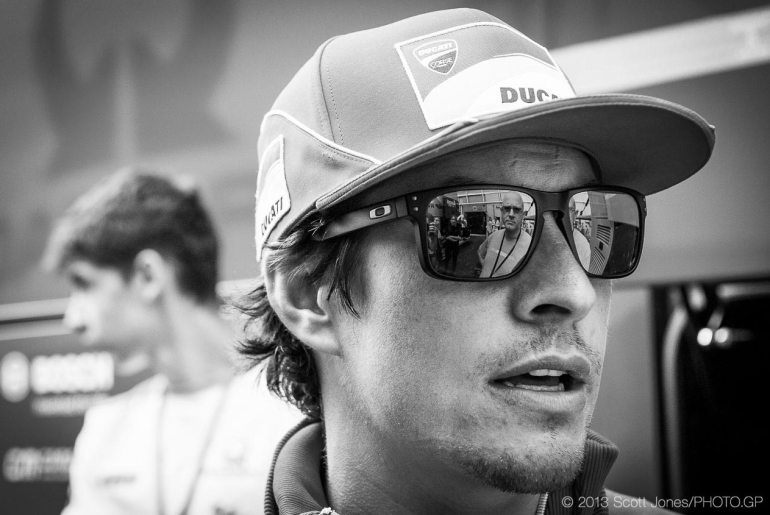
I am very proud to announce that my good friend and colleague David Emmett (check the reflection in Nicky’s sunglasses) has been named, not once, but twice in the 2013 Silverstone Media Awards for his coverage of the MotoGP Championship and for his website MotoMatters.

For the third year in a row, David has been named the Best MotoGP Blogger, something we already knew here at Asphalt & Rubber, which is why we feature his work, and this year marks David’s first time as the series’ top account on Twitter.

David is too humble to do anything other than announce his hat-trick of trophies, but I have no problems saying that his work is the definitive source for MotoGP commentary.

David’s true journalistic ethic and keen understanding of the internet as a medium of information has quickly distinguished him from his colleagues in the MotoGP paddock, and for all the hard work of his that we read on our computer screens, there is an iceberg of change underneath MotoGP’s murky waters that he has brought about.

Keep up the excellent work my good friend, I think I speak for all the Asphalt & Rubber readers when I say that Silverstone couldn’t have recognized a better man in MotoGP.

If you want to help support David’s site MotoMatters, you can take out a subscription; get one of the stunning MotoMatters.com 2014 Motorcycle Racing Calendars; buy a print from Scott Jones’ website; or simply make a donation.

If you didn’t watch Thursday’s pre-event press conference for MotoGP at Jerez, it is worth a viewing right to the end (assuming you have a MotoGP.com account). Building off the news about the NBA’s Jason Collins coming out as gay in a self-written feature in Sport Illustrated, my good colleague David Emmett had the courage to inquire about the culture and acceptance of the MotoGP paddock for homosexual riders.

I will let David write in his own words the mood and response to the evening’s press conference, as well as address the comments, criticisms, and opinions put forth later on Twitter by members of the paddock, when learning about the event. For the sake of accuracy though, after the jump is a full transcript of David’s question, as put to riders Cal Crutchlow, Jorge Lorenzo, Marc Marquez, Andrea Dovizioso, Stefan Bradl, and Scott Redding, as well as those riders’ responses to David’s inquiry.

Indianapolis is not given to great racing – a lack of use on the infield road course means that the track is usually fairly dirty once you get off line – and Sunday was no real exception. The MotoGP and Moto2 races were tactically brilliant and masterful displays of crushing the opposition, but neither was particularly entertaining to watch. Fortunately, nobody had told the Moto3 riders about the lack of great racing, and the youngsters got the day off to a fantastic start, with the race decided in the last sector of the track.

MotoGP has a love-hate relationship with the Indianapolis Motor Speedway: most of the paddock love the place, the rest hate it. The way those feelings are divided is what is really interesting, though: the admirers of the track include most of the media, the teams and many, many fans. Those that hate the track are a small but well-defined group: anyone either wielding a camera or a racing a motorcycle have very few kind words for IMS.

So why the schism? It really depends on what you are doing at the track: the circuit has some of the best facilities of any circuit the MotoGP circus goes to all year, making the life of the media, the teams and the fans exceptionally easy. The photographers, on the other hand, hate the track because of the fences. As a circuit that mainly hosts car races, there are high chain-link fences all around the circuit, to prevent debris from wrecked four-wheelers from flying into the spectators.

At a few selected spots on the circuit, there are openings in the fences for photographers to poke their lenses through, giving them an unobstructed view of the circuit. There are lots of photographers and relatively few camera holes, leaving gaggles of photographers gathered around the available shooting spots like narwhals around a breathing hole in the arctic icesheet.

Laguna Seca has a habit of throwing the Championship a curveball. The epic race between Casey Stoner and Valentino Rossi in 2008 was a prime example, a turning point in the Championship when Rossi halted what looked like the inexorable rise of Casey Stoner. Last year, too, Laguna proved to be key moment in the Championship, when Stoner stopped Jorge Lorenzo’s resurgence with one of the bravest passes in racing for a long time, through the ultra-fast Turn 1. With Laguna Seca the last race going into the summer break, winning or losing at the US GP can have a dramatic effect on the momentum of the Championship.

Whether the same will be said of Laguna Seca in 2012 will only be clear at the end of the season. But it has all the signs of being a significant moment, for more than just the five points Casey Stoner clawed back from Jorge Lorenzo. The race, if not thrilling, was at least tense: there was little between the two men for most of the race, Stoner shadowing Lorenzo closely, snapping at his heels but not quite able to attempt a pass. The turning point came on lap 18. As the leading pair plunged down the Corkscrew, Lorenzo’s sliding rear tire almost threw him out of the saddle. “I closed my eyes during the highside,” the Yamaha man said afterwards, “and I was happy to still be in the seat when I opened them again.”

Cheating in motorsports is as old as the sport itself. Whenever powered vehicles gather together to race each other, then someone, somewhere, will try to gain an advantage, either within the rules or, if that is not successful, outside of the rules. In all classes, and at all times, teams, engineers and riders have all tried to cheat in one way or another. Even the imposition of a spec engine in the Moto2 class hasn’t prevented teams trying to cheat, and the paddock is awash with rumors regarding which teams are cheating and which teams are not.

The finger of blame is inevitably pointed at the most successful riders, and in recent months, it has been pointed mainly at Catalunya CX rider Marc Marquez. Marquez has a number of strikes against him, making him a popular target for rumors of cheating; firstly, Marquez is Spanish, and as Moto2 is a Spanish-run series, the non-Spanish teams are all fervently convinced that Spanish teams are not monitored as closely as they are.

Secondly, Marquez has the backing of Repsol, one of the more powerful sponsors in the paddock, exerting influence not just over Marquez’ Monlau Competicion team, but also over the much more important factory Repsol Honda team; the power of Repsol, the gossips suggest, exerts undue influence on the policing process. Thirdly, and most obviously, Marquez is fast, almost suspiciously so. The Spaniard’s bike is always one of the fastest through the speed traps, and accelerates hardest off the corners. His team put it down to hard work at finding exactly the right set up for Marquez to excel. One of the lighter Moto2 riders on a well-prepared bike, ridden by a fast and talented rider? That, Marquez’ supporters argue, is reason enough for him to be fastest.

To find out more about the situation, and what Dorna and the scrutineers are doing to address these concerns, I spoke to Race Director – and formerly Technical Director – Mike Webb at Estoril. I passed on the concerns that others had expressed to me about cheating in Moto2, and he explained to me exactly what Dorna are doing to monitor the bikes and ensure that cheating is kept to an absolute minimum, and that if it is happening, it does not pay. Here is what Webb had to say:


One of the most fascinating areas of MotoGP is the relationship between rider and crew chief. The way that those two individuals communcate and interact can be the difference between winning championships and riding around mid-pack. Riders need a massive amount of talent to go fast, but they also need to understand what the bike is doing underneath them and be able to communicate that to their chief engineer. Likewise, crew chiefs have to have a solid grounding in race bike physics and an understanding of how to make a machine that is capable of lapping very fast, but they also need to be able to listen to what their rider is really saying, and understand what he needs to allow him to go faster.

It is a subject that has fascinated me for a long time. At Estoril, I had the chance to interview Jorge Lorenzo together with his crew chief Ramon Forcada. 2010 World Champion Lorenzo came into MotoGP off the back of two 250cc World Championships in 2006 and 2007, and was joined by Forcada, a 20-year veteran of the Grand Prix paddock, in the factory Yamaha team. Both men were known for their ability, but they had to find a way to work together to get the best out of the relationship, and out of the Yamaha M1. Here is what they had to say about how that relationship works:

The weight increase in the MotoGP class introduced for 2012 – from 153kg, as originally agreed when the 2012 regulations were drawn up back in August 2010, to 157kg – has had many repercussions. The addition of 4kg to the 1000cc MotoGP machines has been blamed for causing the chatter that Honda’s RC213V suffers from, and for complicating the pursuit of the ideal weight distribution for both Honda and Yamaha, which the two Japanese factories had spent most of 2011 perfecting ahead of the 2012 MotoGP season.

The decision was taken in a Grand Prix Commission meeting held on December 14th of 2011 in Madrid, and though it drew little comment at the time, once the MotoGP paddock reassembled at Sepang for the first test of the year, some intriguing details started to appear. Crash.net’s Peter McLaren has an excellent reconstruction of the decision process, from which it is clear that the path to adoption the proposal faced was far more complex than usual. It also reveals some of the underlying tensions in both the Grand Prix Commission and the MSMA which will go on to play a major role in the rule-making process for 2013 and beyond.

The obvious point to make in the 2011 MotoGP Championship is that Ducati Corse is struggling to compete with Yamaha and Honda, despite having the G.O.A.T. himself, Valentino Rossi, riding for the Italian squad. The recent history of the Desmosedici is fraught with bullet points of issues, most of which coming back to the bike’s notoriously vague front-end. Though showing moments of promise, even brilliance, including a World Championship with Casey Stoner at the helm, the Ducati Desmosedici has earned the reputation as a career-ender and a confidence destroyer among its less fortunate pilots.

When the dream team of development came to Ducati, in the guise of Valentino Rossi and Jeremy Burgess et al, the talk before the 2011 season was that the nine-time World Champion and his perhaps even more impressive garage crew could have the Desmosedici figured out in no-time at all. With the now infamous quote from Burgess that the GP10 could be sorted out in about 20 seconds still resonating in the MotoGP paddock, we stand now well over half of the way through the current MotoGP season, and the Championship standings hide what’s been apparent from day one: the Desmoproblema requires more than a quick-fix.

The solution to fixing the Ducati Desmosedici can be broken down into three camps, and depending whose opinion you solicit, you’ll get one of the following causes for Ducati’s uncompetitive season: the motor, the chassis, or the rider. Walking us through that analysis is our good friend David Emmett (bookmark his site MotoMatters.com right now), who may not be the most astute automatic transmission driver we’ve ever seen, but when it comes to comprehensive MotoGP analysis, the man is second to none.

Putting together an exhaustive digest on the issues that are surrounding Valentino Rossi, Ducati Corse, and the Desmosedici, Emmett weighs and measures the different dynamics of the problem at hand. Head on over to MotoMatters with your beverage of choice in-hand, and hear what MotoGP’s most-enlightened journalist has to say on the biggest subject in MotoGP.

Photo: © 2011 Scott Jones Photography – All Rights Reserved